
The hardest part of building an Australian clothing label is rarely the design; it is finding a clothing manufacturer for Australian brands that will take a first order seriously. Local factories quote high or turn small programmes away, and offshore options feel like a leap into an unknown. Indonesia has quietly become the answer for a growing number of local labels: duty-free entry under the IA-CEPA agreement since July 2020, production costs local factories cannot match, and a manufacturing culture that welcomes brands starting at 500 pieces.
Here is what the journey actually involves, from a first email to garments on a rack in Sydney or Brisbane.
Why are Australian labels choosing Indonesia over local production?
Fashion Journal has interviewed Australian founders on this exact decision, and their reasons repeat: producing locally is often impossible at the quantities a young label can commit to, or the per-piece price destroys the retail maths. Deepwear’s comparison of onshore versus offshore for Australian brands adds the other half of the truth: offshore brings lower labour costs along with shipping, duties and lead times, so the winning brands are the ones who manage those three rather than pretend they do not exist.
Indonesia keeps earning its place in that comparison. Dr Sheng Lu’s apparel sourcing outlook for 2026 finds Asia still the most competitive sourcing region as brands spread their risk across more than one country. IMARC projects Indonesia’s textile manufacturing market growing at roughly 4.8% a year through 2034, which means capacity, skills and fabric supply keep deepening rather than thinning. And the geography is on your side: garments from Java reach Australian ports in days at sea, not the weeks an order from Europe or the Americas would spend on the water.
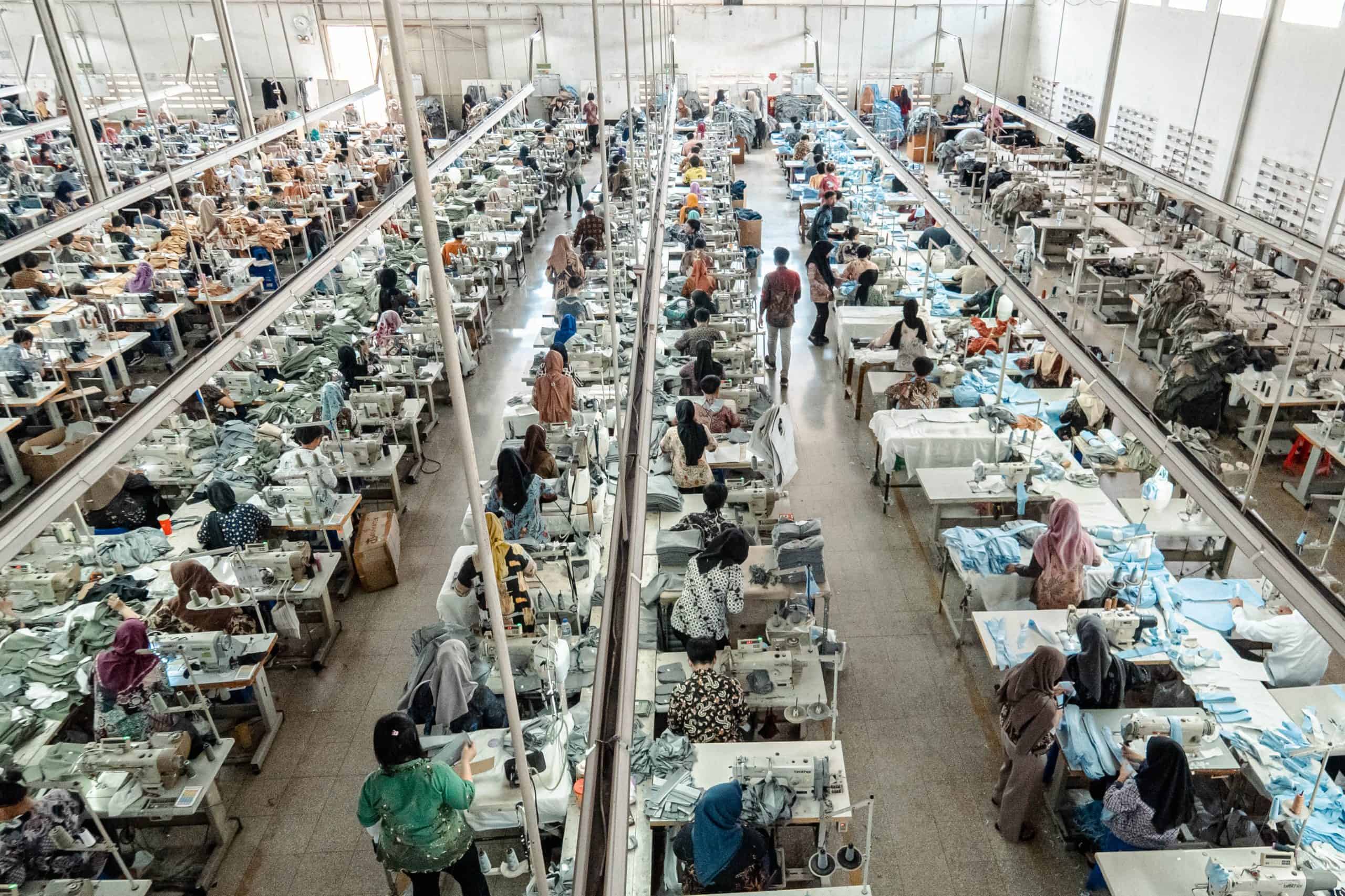
Kizen Lab manufactures clothing in Bandung (Indonesia) as part of a group producing around 200,000 pieces every month with roughly 700 people. The programmes we run for Australian buyers are FOB: we handle fabric sourcing, trims and production, and the garments ship as finished goods.
What does duty-free entry under IA-CEPA actually save you?
Since July 2020, the Indonesia-Australia Comprehensive Economic Partnership Agreement has been in force, and DFAT describes it as removing tariffs on nearly all products traded between the two countries. Australia’s standard import tariff on clothing sits at 5%. Garments that qualify under the agreement enter at 0%.
Qualifying is paperwork rather than luck. Each consignment needs a certificate of origin confirming the goods meet IA-CEPA’s rules of origin, which Chapter 4 of the agreement defines. The factory issues the supporting documents, the Indonesian Trade Promotion Centre in Sydney notes that its office assists exporters with exactly this process, and your customs broker lodges the certificate with the import entry. On a $40,000 shipment of finished clothing, the difference between paying 5% and paying nothing is $2,000; across a year of orders, that covers a photography budget or the deposit on your next sampling round.
GST applies at the border as it does on any commercial import, so the honest way to plan is on landed cost: product price, freight, insurance if you take it, duty at zero with the certificate, then GST. Our guide to clothing cost per piece for small brands shows how the per-piece number behaves once those real-world lines are added, and why the cheapest factory invoice rarely wins on landed cost.
Can you really start with just 500 pieces?
Yes. Kizen Lab runs FOB clothing programmes from 500 pieces per style, woven and non-woven alike. For a label testing a design, 500 pieces is enough to hold a proper launch: size runs, a couple of colourways, real stock in a real warehouse, and sales data at the end of it that tells you what to reorder.
Buyers upgrading from tiny trial runs notice the difference quickly. At 500 pieces the factory can justify proper marker efficiency, dedicated quality checks and a production line that runs your style start to finish rather than squeezing it between larger jobs. The per-piece price sits where the economics work for both sides, and nobody is pretending a 50-piece run can be produced well, because it cannot.
Our sister company World KNK manufactures woven clothing within the same Bandung group, sharing the same standards and the same city.
Every run with Kizen Lab is full-service FOB: we handle the fabric and the parts of production that depend on local knowledge, so your week stays on the decisions that define your label.
How long does the whole process take?
Sampling runs one to two weeks per round, and most styles settle within two rounds. Bulk production typically takes six to twelve weeks depending on the style and the production calendar, then freight to Australia adds days at sea plus a routine clearance when the certificate of origin is in the file. First orders carry an extra week or two while tech packs are finalised; the fastest first orders are the ones where the buyer reads our guide to tech pack mistakes before submitting anything.
Plan backward from your launch date and the timeline stops being stressful. Garments needed for a spring drop in September should have sampling approved by May and bulk booked by June. The buyers who miss seasons are rarely the ones whose factory ran late; they are the ones who started the conversation six weeks before they needed stock on the floor.
What does an FOB price actually include?
FOB (free on board) means the quoted per-piece price covers everything up to finished garments loaded on the vessel: fabric, trims, sewing, finishing, quality checks and packing, plus delivery to the Indonesian port. From the ship’s rail onward, the shipment is yours: ocean freight to Australia, insurance if you take it, customs clearance and delivery to your warehouse. A freight forwarder handles that leg for a few hundred dollars on a typical consignment, and most labels engage one rather than dealing with shipping lines directly.
Two questions to ask any factory quoting FOB: which fabric the price assumes, and what happens to the price if that fabric’s market price moves before booking. A clear answer on both is the mark of a factory that has done this before.
How do you pick a clothing manufacturer for Australian brands you can trust?
The honest answer is process, not luck. A complete tech pack before sampling, a sealed sample approved before bulk, and a written production status with photographs every week during the run. Add a pre-shipment inspection before anything boards the vessel, and the surprise quotient drops to nearly zero. None of this is exotic; it is simply what a factory confident in its own work offers without being pushed.
Communication style tells you as much as certifications do. The questions worth asking a clothing factory before you sign apply doubly across a border: who answers your email, how fast, and what happens when something goes wrong at 11pm their time. If you would like a second opinion on costs before you commit anywhere, our shipping guide from Indonesia breaks down the freight leg line by line.
Frequently asked questions
Do I pay duty on clothing imported from Indonesia?
Not when the shipment qualifies under IA-CEPA, in force since July 2020. With a certificate of origin lodged with the entry, clothing enters Australia at 0% instead of the 5% standard rate. GST applies as normal at the border.
Is 500 pieces enough for a first order?
For testing a design properly, yes: 500 pieces per style supports size runs and colourways and produces real sales data. Many Australian labels start there and reorder against what sells.
What is included in an FOB price?
Fabric, trims, production, finishing, quality checks and packing, delivered to the Indonesian port. Ocean freight, insurance and Australian clearance are arranged from your side, usually through a freight forwarder.
How long until my order reaches Australia?
Sampling one to two weeks per round, bulk six to twelve weeks, then days at sea to Australian ports plus routine clearance. First orders add time for tech pack finalisation.
Do I need anything special to import commercially?
Australian businesses import clothing routinely; your customs broker handles the entry and the IA-CEPA certificate of origin. Most labels find the paperwork lighter than expected once the first shipment has cleared.
Related Articles
- China Plus One: Test Indonesia From 500 Pieces
- Promotional Apparel That Survives Real Washing
- Should You Pay for Samples? The Honest Answer
- Questions to Ask a Clothing Manufacturer (Factory Answers)
- Singapore Uniform Manufacturer from 500 Pieces
- Salon & Barbershop Staff Uniforms from 500 Pieces
- Australian uniform manufacturing
- Beauty Academy Uniforms: Tunics from 500 Pieces
- Music & Arts School Staff Uniforms from 500 Pieces